

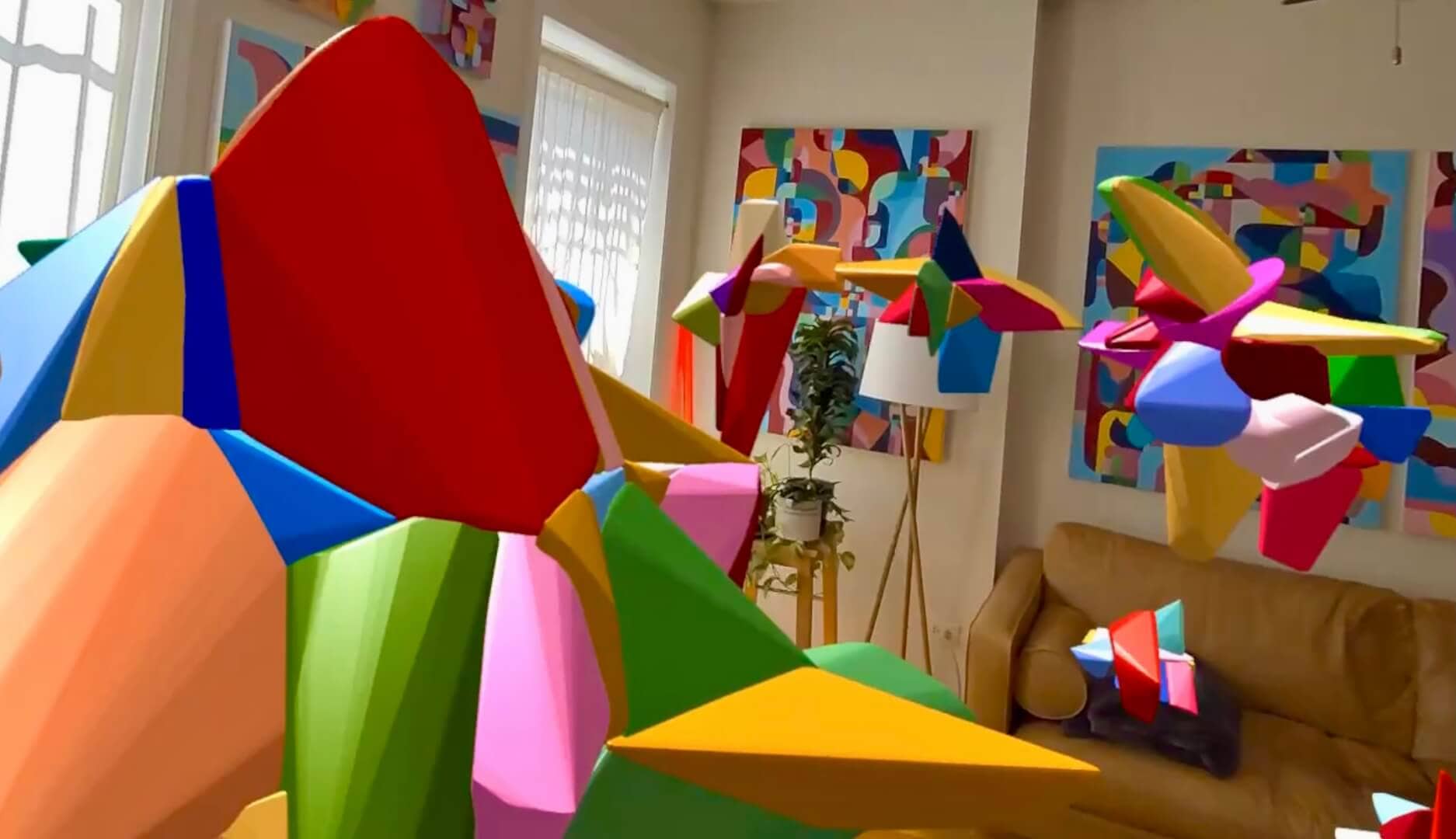
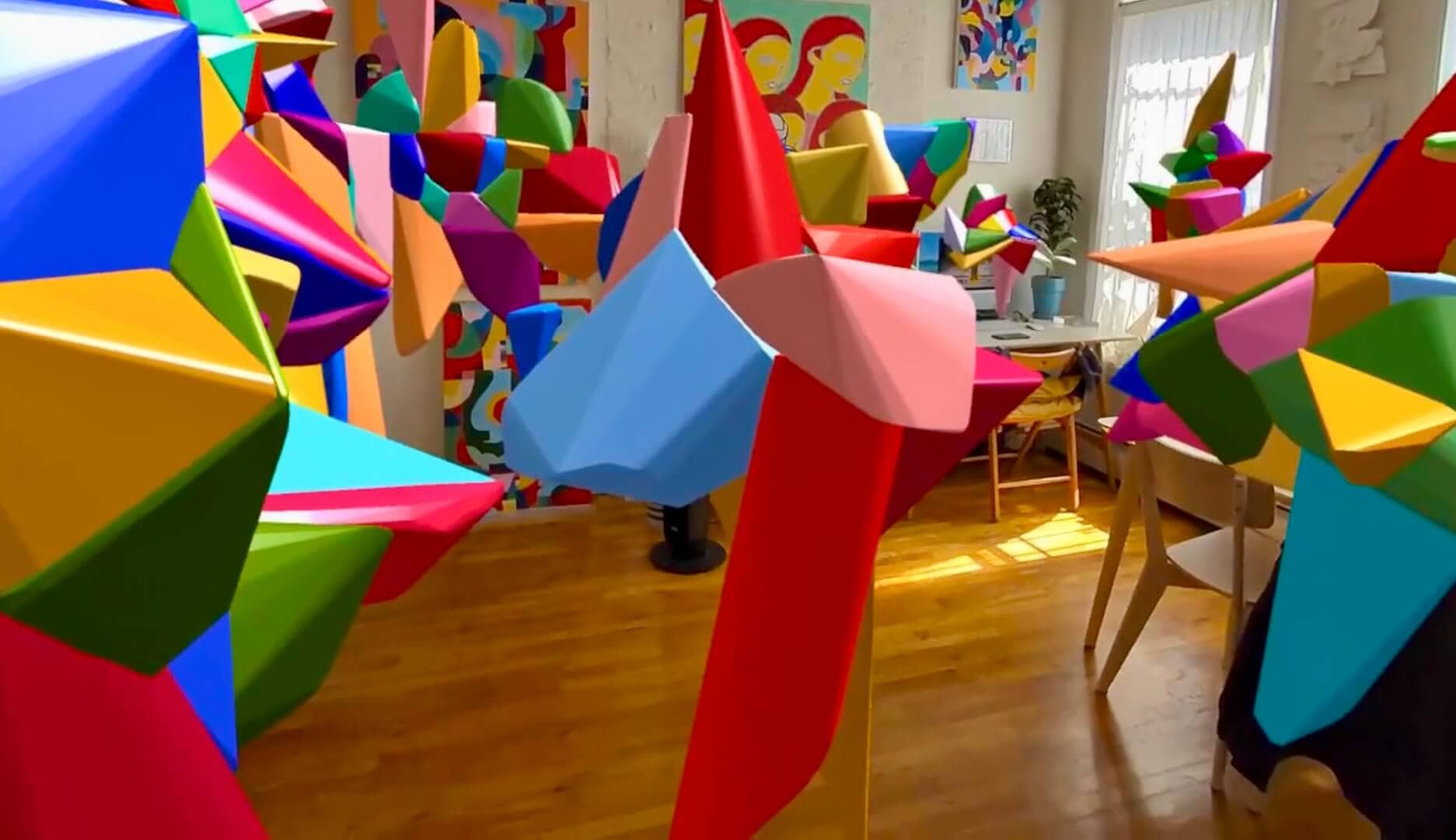
Over the last few weeks I have been developing a new series of VR paintings and spatial experiments inside my studio. What started as an investigation into translating flat painted forms into dimensional objects has quickly evolved into something much larger. The paintings are no longer staying on the wall.
For years my work has focused on shape language, fragmentation, layered abstraction, rhythm, interruption, accumulation, and building visual systems through painting and drawing. Much of that language existed inside the limitations of the canvas. Even when the paintings became large, the wall still acted as a boundary.
Now that boundary is starting to disappear.
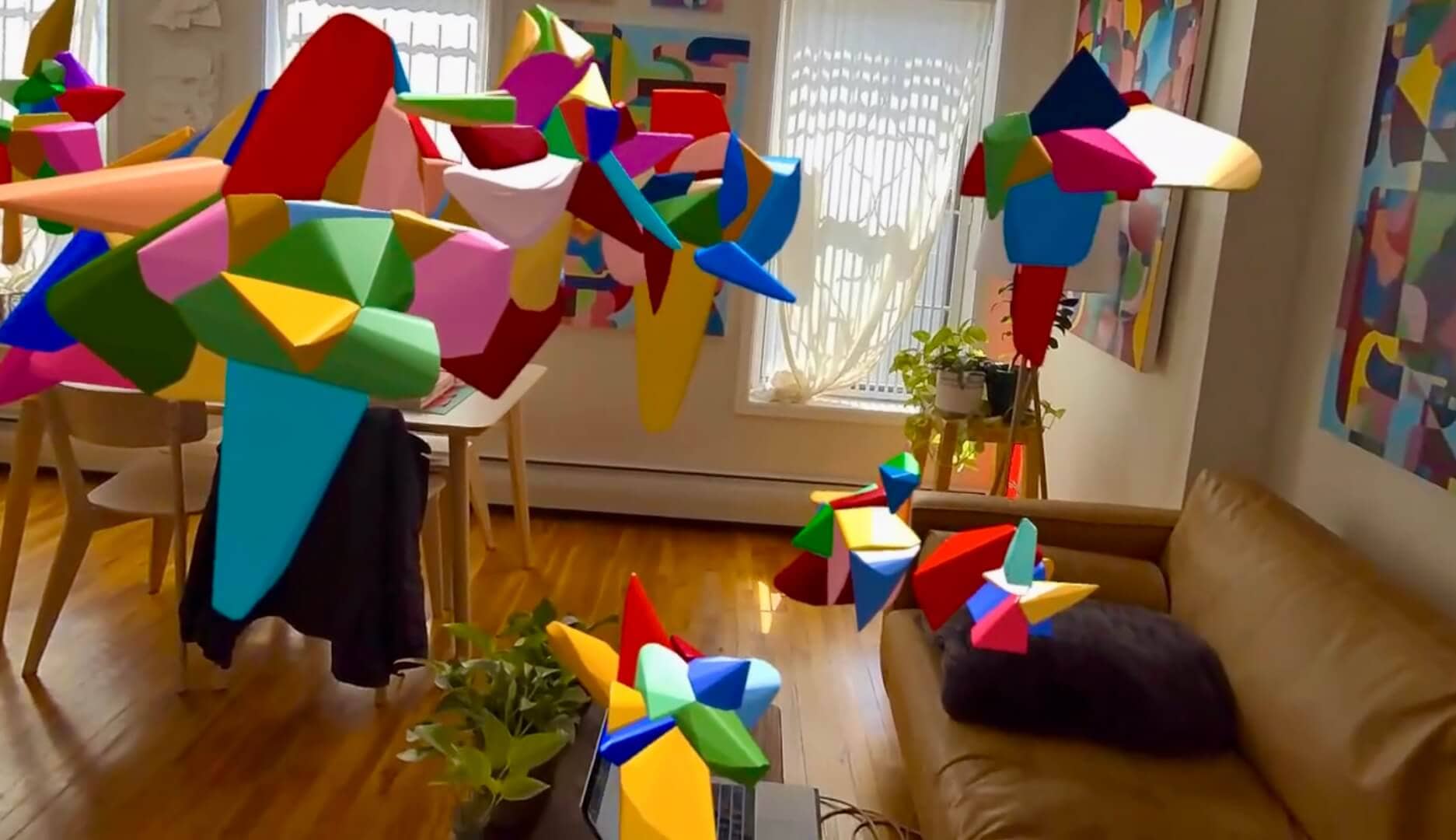
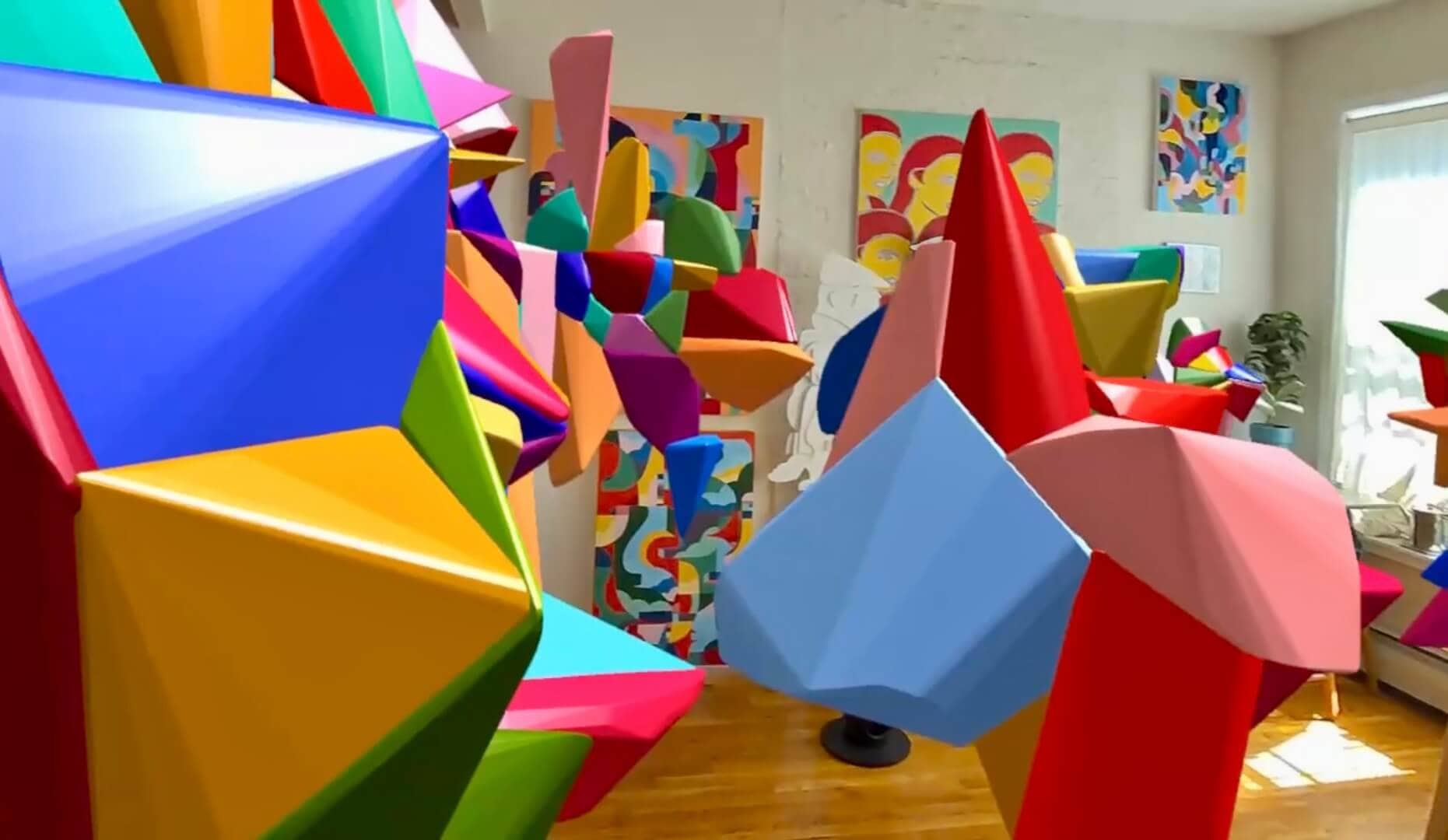
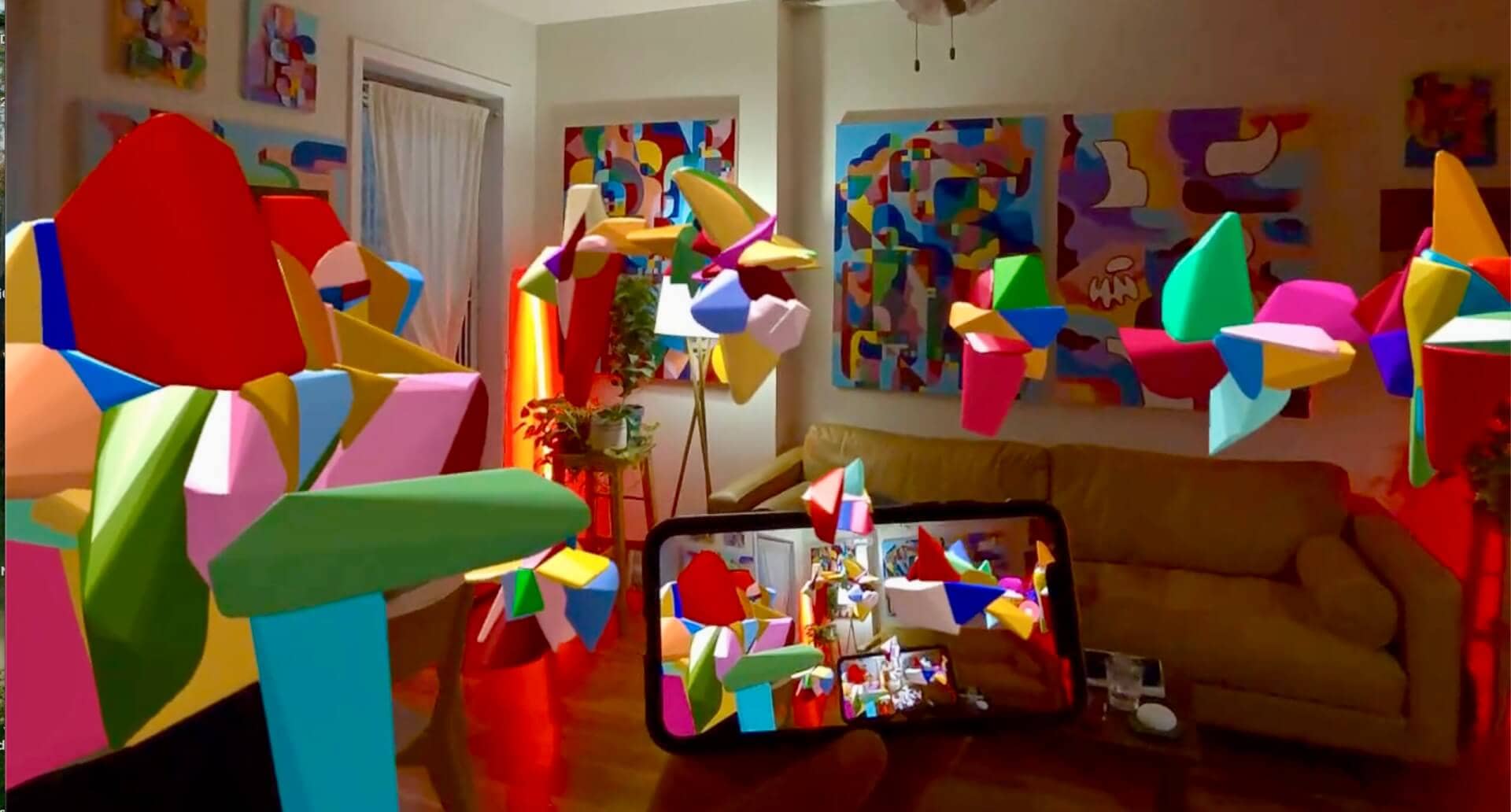
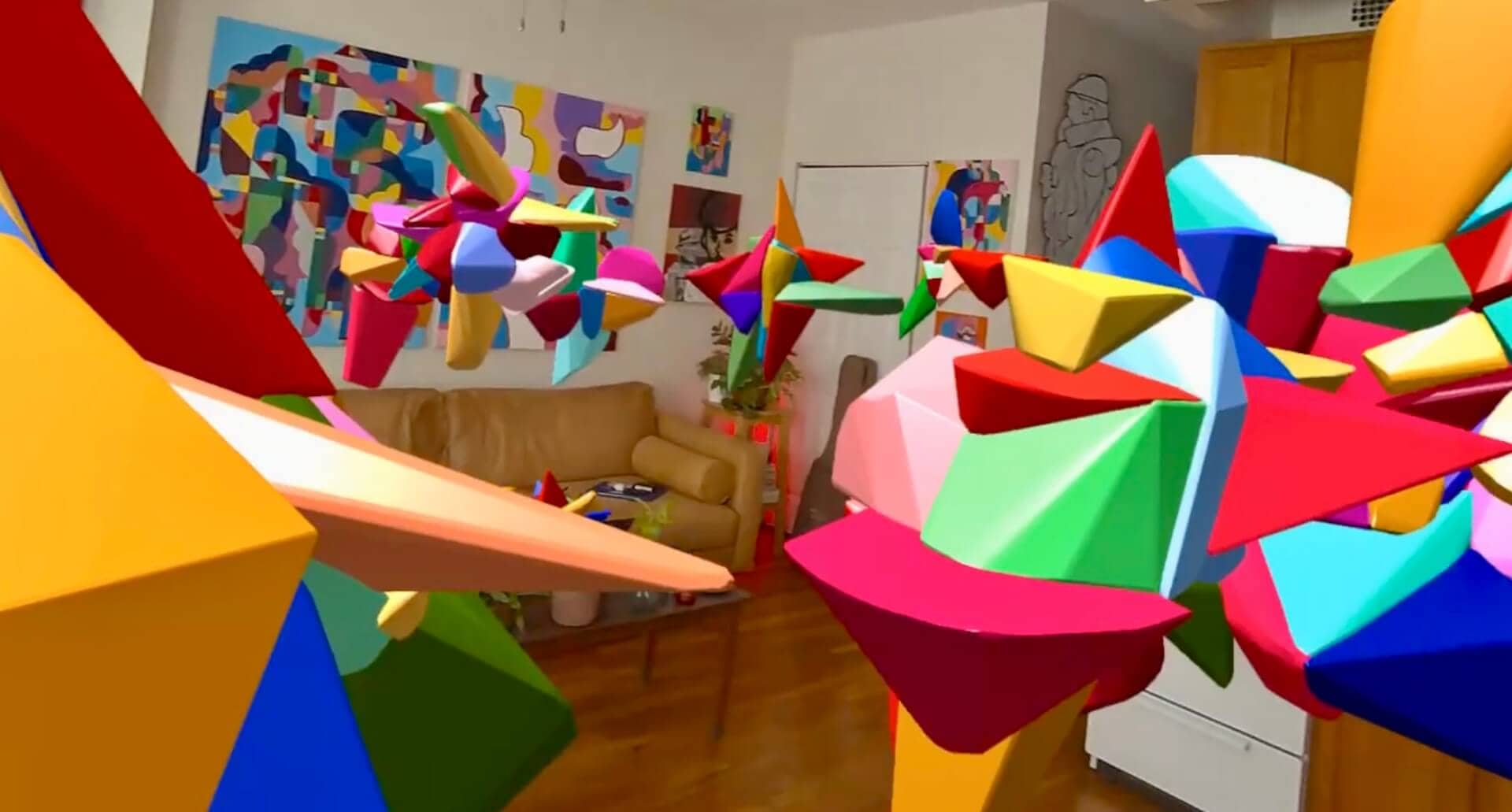
Using VR and spatial computing art making tools, I have been pulling forms directly out of my paintings and extending them into the studio itself. Shapes that once lived only inside the surface of the canvas now hover in space, collide with furniture, float through hallways, interrupt architecture, and transform entire rooms into immersive environments.
The deeper I move into this work, the more I keep thinking about Kurt Schwitters and the Merzbau. In my opinion, Schwitters is one of the most important artists of the twentieth century because he understood that drawing and painting did not need to remain flat. His collages eventually expanded into architecture, installation, and total environmental transformation. The Merzbau was not simply sculpture. It was an evolving spatial system built from accumulated visual thought.
That idea feels incredibly alive right now.
What I am exploring is not a recreation of the Merzbau, but a continuation of some of its core logic through contemporary tools and computational space. Instead of physically attaching material to walls, I am building immersive spatial paintings that can continuously evolve, scale infinitely, and adapt to different environments in real time.
The studio has become the testing ground.. as always!
The paintings now behave like living structures. They occupy the same rooms where the original canvases were painted. The forms move beyond the surface and begin interacting directly with architecture, light, movement, and the body itself. Some moments feel like sculpture. Other moments feel like walking through a painting while it is still being formed.
These experiments are also shifting the direction of my work long term. These pieces can be isolated as individual assets, exported to .glb files formats for AR, Mixed Reality and then-some! (More on this soon)
I am increasingly interested in expanding these spatial painting systems beyond the studio and into large-scale site-specific installations for museums, galleries, public spaces, hotel lobbies, airports, and architectural environments. I do not see these works as isolated VR objects or temporary tech demonstrations. I see them as the beginning of a new form of immersive painting and spatial storytelling that can exist simultaneously across physical and virtual space. Watch the video below to see a screencasted walkthrough with my headset.
The goal is not escape from reality.
The goal is transformation of space itself.
I want people to walk through paintings. I want architecture to become part of the composition. I want digital forms to interact with real environments in ways that feel alive, emotional, immersive, and impossible to fully contain. I want the assets to be programmed and able to deploy utility and interaction.
This feels less like entering virtual reality and more like expanding painting into another dimension.
The studio is simply where it begins.
More AR, VR and MX coming to the RSMAD very soon!

Technical Workflow / Spatial Computing Stack
This project was developed using the Meta Quest 3 headset together with Open Brush, an open-source virtual reality painting application originally derived from Google Tilt Brush.
Using the Meta Quest 3 passthrough mixed reality mode, I am able to paint directly into physical space while still seeing the architecture of the studio around me in real time. This allows digital forms to occupy actual environments rather than existing inside isolated VR simulations.
The workflow combines:
- painting
- sculpture
- installation thinking
- spatial computing
- embodied drawing
- immersive environment design
- mixed reality interaction
Project Type: Virtual Reality Research
Category: Creative Technology
Medium: Virtual Reality / 3D Spatial Design
Tools: Meta Quest 3, Open Brush
Year: 2026