

A Handful of Synthetics – 2004-2025
In 2004 I found myself holding a paradox. I had scooped a fistful of earth and embedded it into the mold of a drinking cup, casting it in clear acrylic resin. What emerged was neither purely natural nor entirely artificial but a collision of the two. The earth was now locked inside a toxic man made material, permanently preserved in a way that nature never intended. My natural hand cradled the synthetic form while my other hand held a digital video camera, snapping a grainy frame in an era when low resolution was standard. Behind me, my studio swirled in chaos. Door handles, scraps of wood, tape, outdated disks, plastic, metal, paper. Everything man made, everything synthetic.
The piece was titled A Handful of Synthetics, and it was both sculpture and mirror. It reflected the early twenty first century back to me in a raw and unresolved state. What does it mean to fix nature inside a material that cannot decay? What happens when we frame the earth itself in a vessel of human invention? When I rediscovered the image on September 19th, 2025, I pulled it forward through another snapshot, this time with my computer’s screenshot tool. The frame now included a modern web browser. Twenty one years after that first capture I was no longer documenting a studio experiment but instead seeing layers of time, materials, and technologies stacked on top of one another. Earth, resin, hand, video camera, computer, browser. Each stage revealed how humans constantly mediate between what is natural and what is synthetic.
The relationship between earth and resin is uneasy. One decomposes, the other resists decay. One is fragile, the other is stubborn. Yet they are interdependent, locked in a kind of partnership. My body itself, the hand holding the object, sits between these two worlds. We rely on natural systems to survive, yet we also rely on synthetic inventions to extend and accelerate our evolution. Even the act of embedding earth into resin becomes a metaphor for how we embed ourselves into technologies, knowing they are both toxic and transformative.
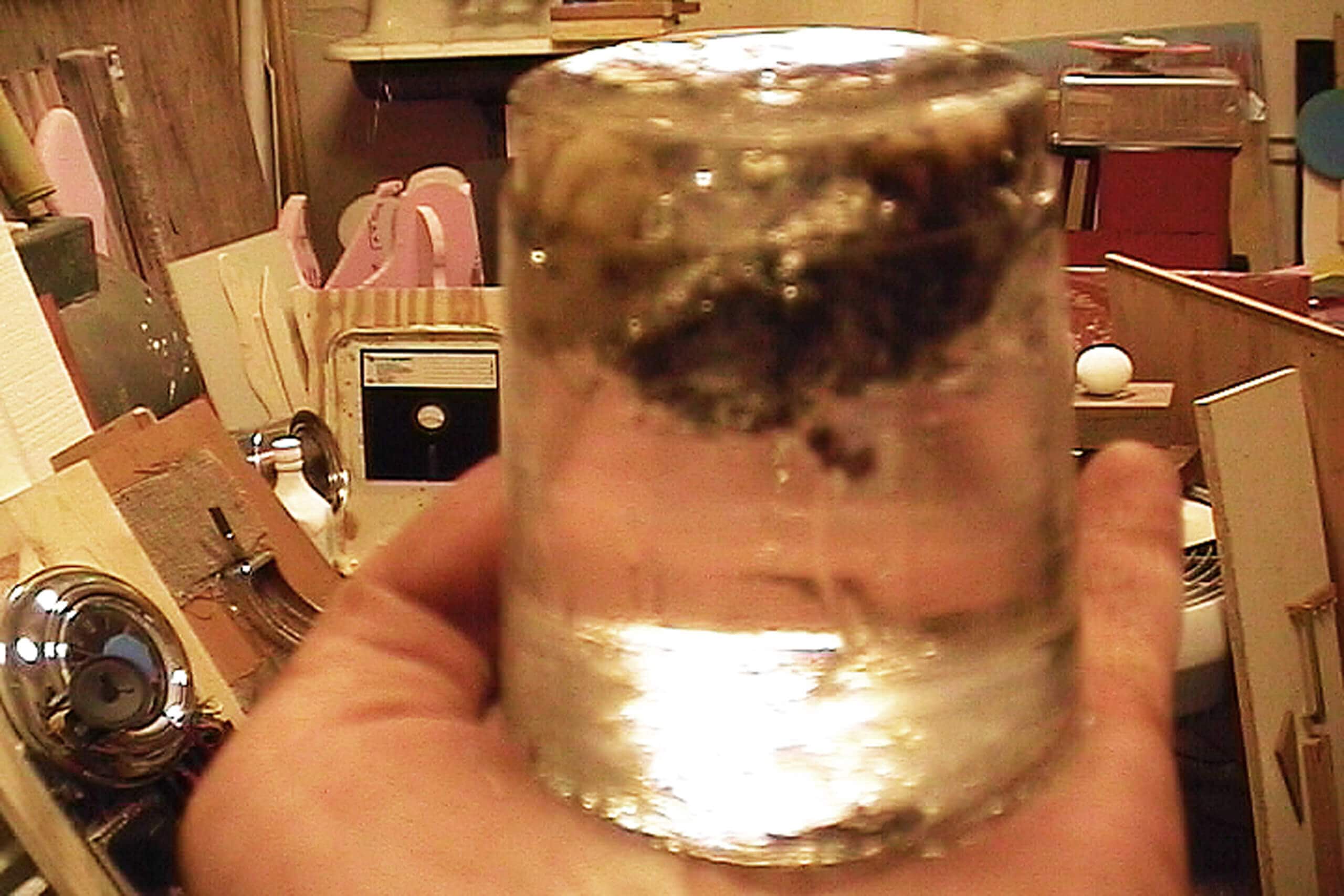
In 2004 I did not understand the role the internet would play in this dialogue. The browser in my 2025 screenshot feels like a ghost that was always present but unseen. Back then I was more concerned with material experiments, with the tactile act of sculpting and collaging. Yet the very documentation of this piece through video and digital photography was already pulling me into the digital ecosystem. The camera’s grainy resolution became an aesthetic choice. It captured not only the object but the imperfections of its time. By re screenshotting the image now, another layer of mediation is added. The browser itself becomes part of the composition, showing how much of our memory, archiving, and storytelling depends on digital infrastructure.
Today the piece feels less like a relic and more like a prophecy. The collision of natural and synthetic materials has only intensified. We are surrounded by plastics and polymers that will outlive us while the natural world struggles under extraction and containment. At the same time technologies like AI and blockchain push us into realms where even memory and authorship are becoming synthetic. The earth in my hand could just as easily be a dataset sealed inside a machine, fragile but enduring, preserved in systems we barely understand.
The chaos of the studio in the background is just as important as the resin object. It reflects the overwhelming abundance of human made things. It is an environment of invention and saturation. Looking at it now I see not only chaos but an ecology of dependence. Every synthetic fragment was once natural. The wood came from trees, the metal from mines, the disk from oil turned into plastic. Nothing synthetic exists without nature, and nothing natural remains untouched by the synthetic.
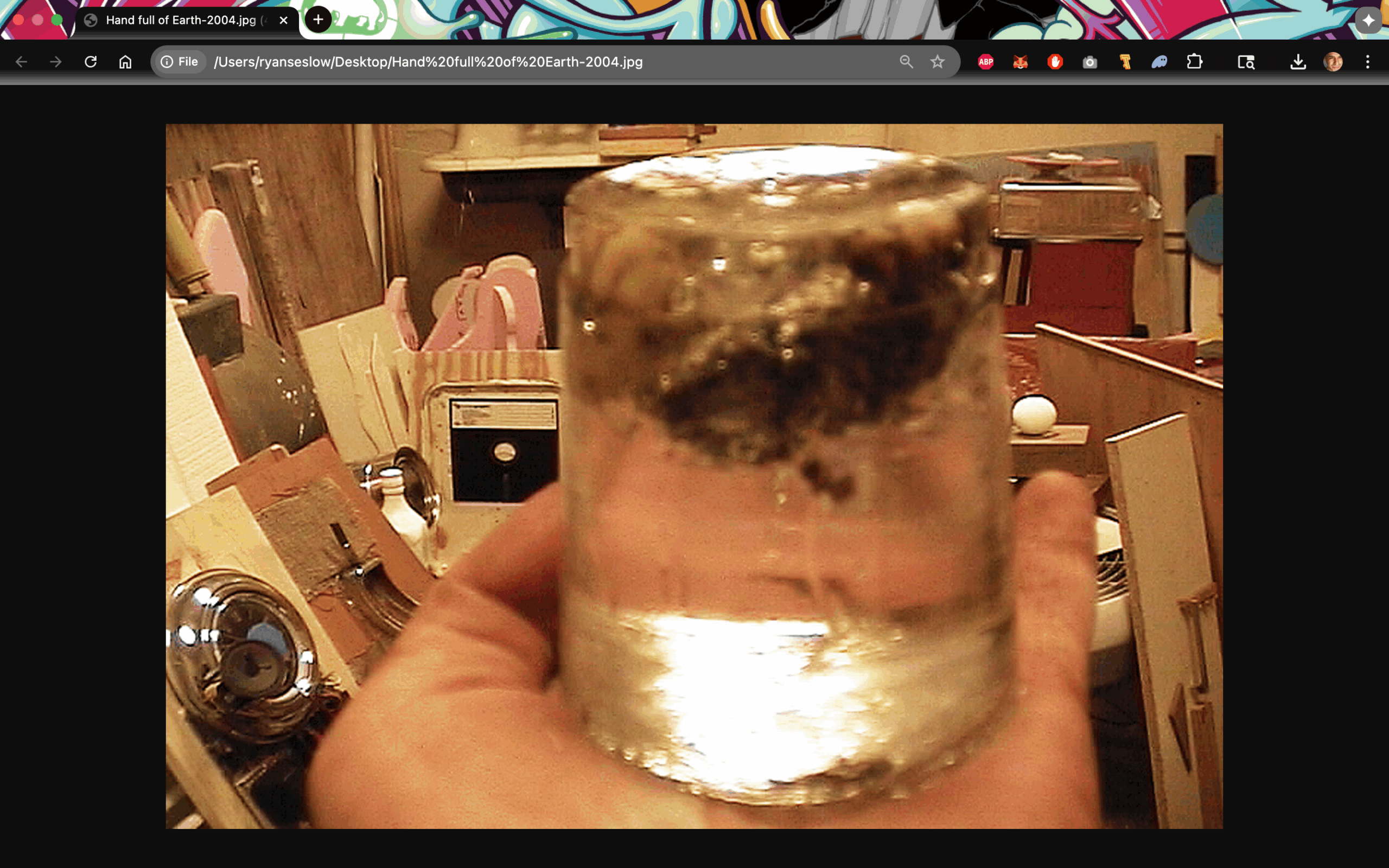
Revisiting A Handful of Synthetics in 2025 forces me to think about preservation. What is the lifespan of an artwork? The resin cup itself may have yellowed or cracked, yet the digital image persists. By layering images across decades I have created a kind of time capsule. The work has become less about the object and more about circulation and reinterpretation. Each stage adds meaning. The 2004 object was about material tension. The 2025 rediscovery is about technological mediation and how memory evolves through devices.
This is not nostalgia. It is not only looking back at what was. It is a dialogue across decades, mediums, and tools. It shows how natural and synthetic forces remain in constant negotiation, how human evolution is entangled with both, and how art functions as a witness to that entanglement. What began as a lump of earth encased in resin has become a layered narrative of how we preserve, archive, and reframe our world. It reminds me that chaos and codependence are not failures but conditions of existence. The natural and the synthetic cannot be separated because their futures are bound together, just as my hand was bound to the object in 2004 and just as the browser is bound to the screenshot in 2025. A Handful of Synthetics continues to evolve. It asks us to consider how we hold the earth, how we embed it in our inventions, and how we document those gestures through time. Every act of creation is also an act of preservation, and every preservation carries both loss and possibility.
Do You Want to See More of My Past & Current Projects? – Go Here <—


