
AREMES HQ, Brooklyn, October 10th 2026
Cross-posted from AREMES Enterprises.
What happens when the characters walk out of the game and into a gallery?
This summer SuperRare asked me for a game. SuperRare Studio was still in beta, and on July 11th The Tesseract Garden went live there, a first person walk through a garden of my blooms. Six days later came The Tesseract Garden II, with a new cast of eleven blooms and real trees. Both are still live, and both are free to play.
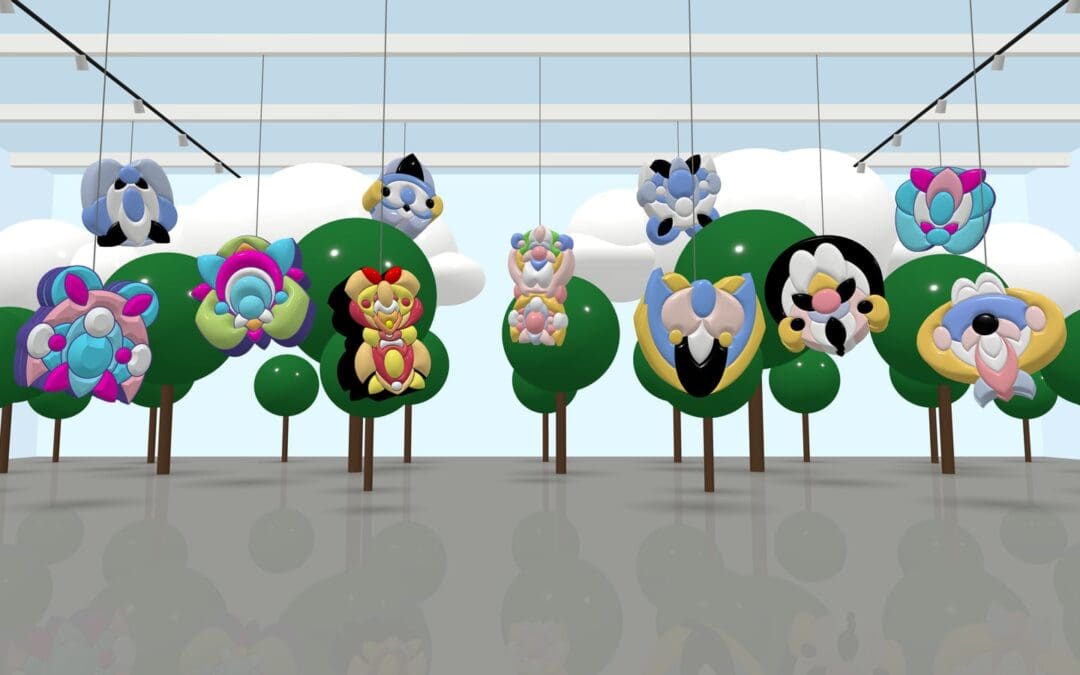
For more than a year aremes-enterprises.com has held up its Tesseract Garden with a single still image: my blooms hanging in a gallery over a grove of round trees. The game gave those blooms bodies. So I took the eleven from the sequel and hung them inside that picture.
This is the first iteration of that room. It is a work in progress, and it is not a fully operational garden yet.
But you can walk it.
The Room
The hall is forty meters wide, thirty two deep and eleven and a half high. Eleven blooms hang on cables in three tiers above twenty two trees. Four clouds drift indoors, under a roof of white steel beams and track lights, and the polished floor carries a reflection of everything above it. No timer. No score. Nothing to collect. You move at your own pace and you look up.
The first walls were white, and the clouds disappeared into them. White on white. So the walls and the ceiling went a very light sky blue. Now the clouds read as clouds, and the room reads as weather.
From the Build Floor
Every bloom begins in Adobe Illustrator as a flat drawing, puffed into three dimensions with the Inflate tool. Inflate only puffs the front. Walk around one of those forms and the back is perfectly flat, a sign standing in a room where a sculpture should be. We can’t have that. So each flat backed bloom is mirrored across its own back plane, and the two puffed faces meet in the middle. Eight of the eleven needed it. The other three were already round all the way through. Walk behind any of them now and a second face is waiting for you.
Click a bloom and a label appears on the wall beside you. Nobody types those labels. A small script reads each file and reports what it finds: triangles, materials, file size, the date it was made. In 2045 we call that provenance by instrument. In 2026 it is called index.mjs, and I trust it more than any caption I could write.

The whole room was built in the terminal with my friend Sir Claude Code, on three.js and WebXR. It opens in the browser on a laptop or a phone, and it opens in a Quest 3. Getting it into the headset cost us an evening. The Enter VR button did nothing, tap after tap, while every one of my earlier VR pieces opened fine. The garden was never the problem. The test server was. The moment the room sat on a real address, the door opened.
Inside the headset you stand underneath them. Look up and the clouds are over your head.
What It Is Not Yet
The AREMES site describes a living garden, one that grows and changes over time. This one holds still while you walk it. Eleven blooms are hung, and more are waiting in the vault. Making it grow is the work ahead.
A first iteration is a seed, not a harvest.
The Rooms Next Door
The Garden does not stand alone. It is one room in a building that has been opening doors all year. Upstairs at HQ is The Ryan Seslow Museum of Art & Design, and out back is the RSMAD Sculpture Park. The teaching side lives across the river on the NET-ART site at the CUNY Academic Commons, with its own walkable NET-ART XR room. All of the spatial work gathers at Spatial.
Same archive. Different doors.
What should grow in it next?
Forward we go, forward we go!
AREMES HQ, Brooklyn


